
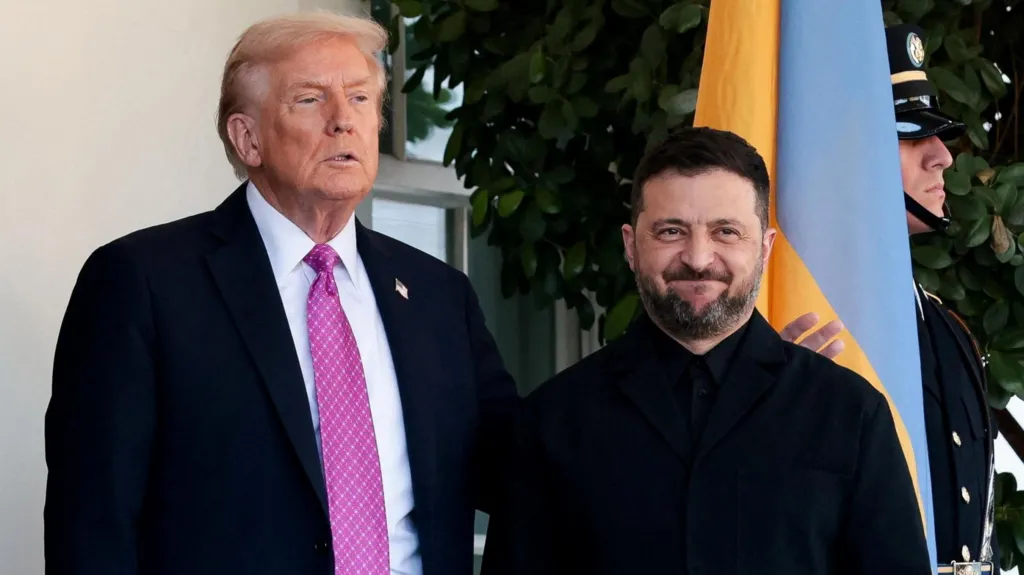
Ukrainian President Volodymyr Zelensky will meet US President Donald Trump in Florida on Sunday, for the latest round of talks aimed at ending nearly four years of war with Russia.
The pair will discuss an updated version of a US-brokered peace plan, which Moscow is yet to support, as well as separate proposals for US security guarantees.
Their meeting at Trump's Mar-a-Lago home follows intense Russian bombardment of Kyiv over the weekend, which the Ukrainian president said is evidence that Moscow "doesn't want peace".
The 10-hour missile and drone barrage targeting Ukraine's capital killed two people and left 32 others injured, local authorities said.
Zelensky is expected to raise security guarantees and territorial concessions for Ukraine in his Sunday meeting with Trump, both of which are issues that Russia has previously been unwilling to compromise on.
They will also discuss the new 20-point peace plan, a revised version of the earlier 28-point plan drafted by US special envoy Steve Witkoff which was widely seen as being too favourable to Russia.
Control of Ukraine's eastern Donbas has been a major sticking point in talks so far, but Zelensky has now said a "free economic zone" could be an option.
Moscow currently controls about 75% of the Donetsk region, and some 99% of the neighbouring Luhansk. The regions are collectively known as Donbas.
The Kremlin has not commented on Zelensky's offer to withdraw troops from the eastern Donbas region, if Russia pulls back too.
But on Saturday, Russian President Vladimir Putin said Ukraine was "in no hurry to resolve this conflict peacefully", according to the Russian news agency TASS.
Putin added that if Kyiv did not want to resolve the conflict peacefully, Russia would accomplish its objectives militarily.
The Ukrainian president has voiced optimism about the new draft of the peace plan, describing it as "a foundational document on ending the war".
On Friday, he told reporters that the 20-point plan was 90% complete: "Our task is to make sure everything is 100% ready."
But in an interview with Politico, Trump warned that Zelensky "doesn't have anything until I approve it".
Trump added that he was expecting to see the new draft on Sunday.
"I think it's going to go good with him. I think it's going to go good with [Vladimir] Putin," Trump said in the interview, adding that he expects to speak with Russia's president "soon".
Following meetings with Canadian Prime Minister Mark Carney, Zelensky said Moscow's latest attack on Kyiv was "Russia's answer [to] our peace efforts and this really shows that Putin doesn't want peace".
Zelensky also took a call with European leaders to discuss diplomatic "priorities" ahead of his meeting with Trump, adding that "strong positions are needed" to move forward with the plan.
Kyiv has the "full support" of European and Nato leaders, according to German Chancellor Friedrich Merz.
Ukrainian officials said that Russia's latest attack on Kyiv caused significant damage to energy infrastructure, with 40% of residential buildings in Kyiv and nearby districts left without heating.
Russia's defence ministry said long-range precision weapons were used to target energy facilities, which it claimed were being used "in the interests of the Ukrainian Armed Forces and enterprises of the Ukrainian military-industrial complex".
Russia directed almost 500 drones and 40 missiles towards Kyiv, targeting energy and civilian infrastructure, according to Ukrainian officials.
Pictures showed gaping holes in apartment buildings and homes on fire following the strikes.
The apartment block of BBC journalist Anastasiya Gribanova was struck, leaving some homes on the higher levels of the high-rise building in flames. Gribanova, who was in the building's elevator at the time, was unharmed.
The attack saw Poland, which shares a 530km-long (320 miles) border with western Ukraine, ready its fighter jets, ground-based air defence systems and radar reconnaissance.
Later on Saturday morning, it concluded that there had been no violation of the country's airspace.
Russia's defence ministry said its air defence systems had intercepted and destroyed almost 200 Ukrainian drones over several Russian regions, including eight over Moscow.
Post a Comment